Meta Description:
Discover how to select and implement the right AI tools to increase profits. Our guide covers writing, video, analytics, and automation for business growth.
1. Introduction: Navigating the AI Profit Revolution
The digital marketplace is noisier and more competitive than ever. As a business leader, you’re bombarded with promises of exponential growth, streamlined operations, and skyrocketing revenue all supposedly unlocked by the latest AI tool. Yet, for every success story, there’s a trail of wasted subscriptions, abandoned integrations, and unclear returns on investment.
The challenge isn’t a lack of options; it’s an overwhelming surplus. How do you, as an e-commerce store owner, agency director, SaaS founder, or consultant, cut through the hype to identify the AI solutions that will genuinely impact your bottom line? This guide is designed to be your strategic compass. We move beyond flashy features to focus on practical, profit-centric applications. We’ll provide a structured framework to evaluate, select, and implement the AI tools that align with your specific business goals, budget, and workflow, turning potential into measurable profit.
2. Understanding the Basics: Core AI Tool Categories for Profit
Before diving into specific tools, it’s crucial to understand the landscape. AI for business profit generally falls into these core functional categories. Identifying which category addresses your most significant pain point or growth opportunity is the first step.
Content & Copy Creation AI
These tools assist in generating, refining, and optimizing written and visual content. They aim to reduce production time, improve quality, and enhance engagement.
- Primary Profit Levers: Scaling content marketing, improving ad conversion rates (CTR), optimizing product descriptions for SEO and sales, personalizing email campaigns.
- Examples of Tasks: Writing blog posts, creating social media captions, generating video scripts, A/B testing email subject lines, crafting high-converting landing page copy.
Customer Intelligence & Analytics AI
This category focuses on deriving actionable insights from data. These tools go beyond traditional dashboards to predict trends, understand customer sentiment, and automate reporting.
- Primary Profit Levers: Dynamic pricing optimization, predicting churn, identifying high-value customer segments, personalizing user experiences at scale.
- Examples of Tasks: Analyzing customer support tickets for common issues, forecasting sales trends, segmenting audiences for targeted campaigns, tracking competitor price changes.
Process Automation & Operational AI
Here, AI is applied to internal workflows to eliminate manual, repetitive tasks. This frees up human capital for higher-value strategic work.
- Primary Profit Levers: Reducing labor costs on repetitive tasks, decreasing operational errors, accelerating project timelines, improving customer response times.
- Examples of Tasks: Automating invoice processing, scheduling social media posts, qualifying and routing sales leads, providing 24/7 basic customer support via chatbots.
Video & Multimedia Creation AI
A rapidly advancing field, these tools simplify high-impact video and audio production, which traditionally requires significant skill and resource investment.
- Primary Profit Levers: Creating cost-effective video ads and product demos, scaling personalized video messaging, repurposing content into multiple formats (e.g., blog to video).
- Examples of Tasks: Generating AI avatars for presentations, creating short-form video clips from long-form content, adding AI voiceovers, editing videos via text commands.

3. Key Considerations Before You Buy
A strategic purchase prevents costly mistakes. Evaluate any potential tool against this checklist.
Align with Your Specific Profit Goal
Never buy a tool because it’s “cool.” Start with a precise goal. Is it to:
- Increase average order value (AOV) by 15%?
- Reduce content production costs by 30%?
- Improve customer retention by 10%?
Your goal dictates the category and feature set you need. A tool great for blog writing may be useless for dynamic pricing.
Evaluate the True Cost vs. ROI
Look beyond the monthly subscription. Calculate the Total Cost of Ownership (TCO):
- Subscription fees (annual vs. monthly).
- Cost of training your team.
- Potential costs for integration with existing software (CRM, CMS, etc.).
- Time cost of implementation.
Weigh this against a realistic projection of the return: How much revenue could improved copy generate? How much time will automation save, and what is that time’s monetary value?
Assess Integration and Learning Curve
A powerful tool that sits unused is a money pit. Ask:
- Integration: Does it plug seamlessly into your existing tech stack (e.g., Shopify, WordPress, HubSpot, Google Analytics) via native integration or Zapier?
- Usability: Is the interface intuitive? What is the estimated time for your team to achieve proficiency?
- Support & Training: Does the vendor offer adequate onboarding, documentation, and customer support?
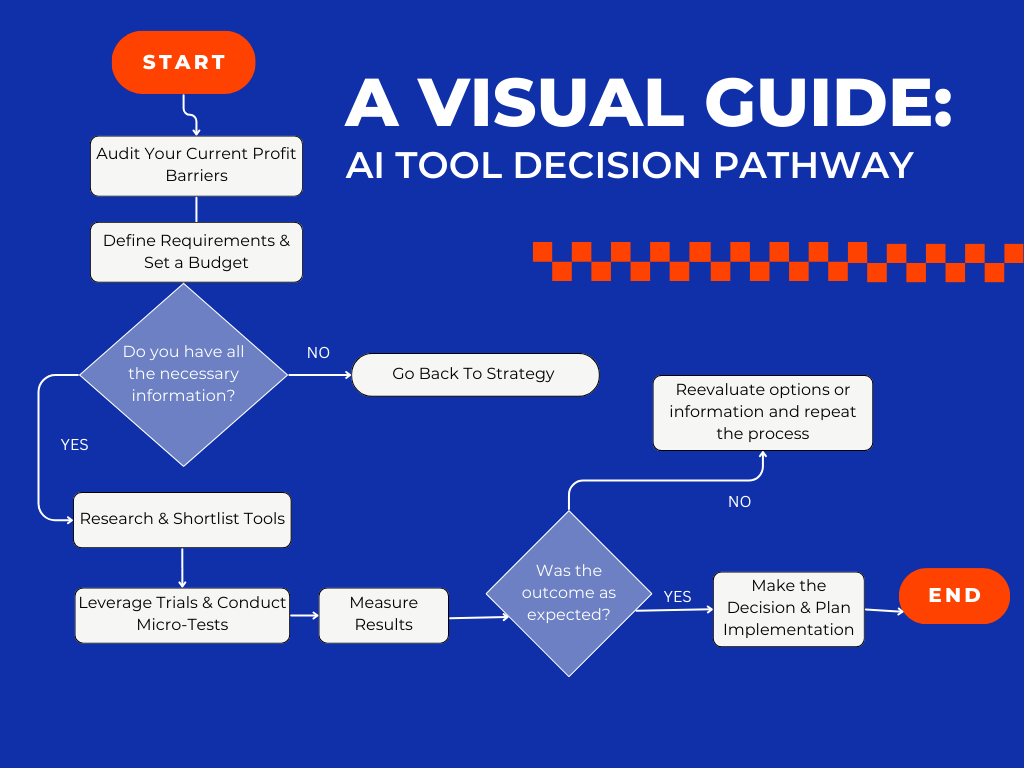
4. Step-by-Step Guide to Selecting Your AI Stack
Follow this five-step process to make a confident, strategic decision.
Step 1: Audit Your Current Profit Barriers
Conduct an internal audit. Where are you leaking money or missing opportunity? Is it high cart abandonment? Slow content throughput? Inefficient customer service? Gather data and feedback from sales, marketing, and operations teams to pinpoint 1-2 high-impact areas to address first.
Step 2: Define Requirements & Set a Budget
Create a “Must-Have” vs. “Nice-to-Have” list for your ideal tool. Must-haves might include “integrates with Klaviyo” or “offers a free trial.” Simultaneously, determine a realistic budget range based on your ROI projections.
Step 3: Research & Shortlist Tools
Use trusted review sites, case studies from similar businesses, and expert roundups (like this one) to create a shortlist of 3-5 tools in your chosen category. Prioritize tools that offer transparent case studies over those making vague grandiose claims.
Step 4: Leverage Trials & Conduct Micro-Tests
Always use free trials or freemium plans. Don’t just explore features run a defined micro-test. For a writing tool, use it to draft a real email campaign. For an analytics tool, import a sample dataset. Measure the tool’s output against your current process in terms of time saved and quality achieved.
Step 5: Make the Decision & Plan Implementation
Choose the tool that best meets your requirements, budget, and proved its value in the trial. Crucially, create an implementation plan before purchase. Assign an internal owner, schedule training, and define success metrics (e.g., “Team will use this tool for 100% of new product descriptions by Q3”).
5. Expert Tips for Maximizing ROI
Implementation is where profit is won or lost.
Start with a Pilot Project
Roll out the tool to a small, controlled project or a single team. This limits risk, allows for process refinement, and can generate quick wins to build internal buy-in.
Treat AI as a Collaborator, Not a Replacement
The highest ROI comes from a “human-in-the-loop” model. Use AI for ideation, first drafts, data crunching, and repetitive tasks. Then, apply human judgment, brand nuance, and strategic oversight. This combines scale with quality.
Continuously Track and Measure
Set up a simple dashboard to track your predefined KPIs. Is the AI writing tool actually improving your email open rates? Is the analytics tool helping you adjust prices more effectively? Review this data monthly to validate the investment and adjust usage.
6. Common Mistakes to Avoid
Learn from the missteps of early adopters.
- Mistake 1: Buying for Features, Not Solutions. You don’t need a tool with 50 features; you need one that perfectly solves 1-2 core problems.
- Mistake 2: Neglecting Team Adoption. If your team resists or doesn’t understand the tool, it will fail. Involve them in the selection process and invest in proper training.
- Mistake 3: Setting and Forgetting. AI tools and the competitive landscape evolve. Regularly (quarterly) reassess if the tool is still serving its purpose and if better/cheaper alternatives exist.
- Mistake 4: Ignoring Data Privacy & Security. Especially for tools handling customer data, review their security compliance (SOC 2, GDPR, etc.). The cost of a data breach far outweighs any tool’s benefit.
7. Conclusion: Building Your AI-Powered Profit Engine
Selecting the right ai tools to increase profits is not a one-time transaction; it’s an ongoing strategic exercise in resource allocation and process optimization. The journey begins with a clear-eyed assessment of your business’s unique profit barriers and opportunities, not with the shiniest new software demo.
By adhering to a disciplined framework defining goals, calculating true costs, ruthlessly testing, and focusing on adoption you transform AI from a costly gamble into a measurable driver of efficiency, growth, and competitive advantage. Remember, the goal is not to chase every AI trend but to build a lean, integrated stack of tools that work as a cohesive profit engine for your specific business.
Start small, measure everything, and scale what works. The future belongs to businesses that leverage AI not as a magic wand, but as a powerful, deliberate instrument of their core strategy.